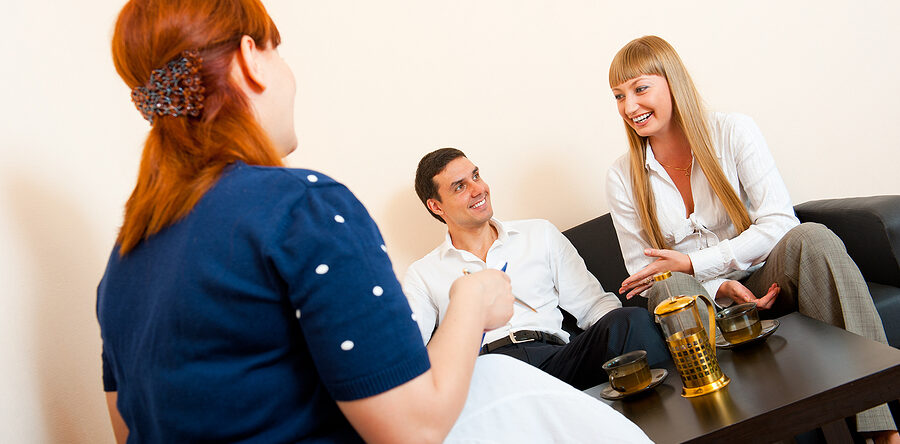
Like other forms of psychotherapy, couples therapy endeavors to relieve people’s suffering and enhance their functioning in one critical area of their lives. But unlike other formats, there are generally three clients in the room along with the psychotherapist. There is each partner in the couple, and then there is the relationship.
In a very dynamic high-wire act, the trained couple’s therapist juggles the needs and interests of all three impartially. Couples come to therapy because they have different points of view about their shared experiences and one or both partners are suffering significantly. Sometimes one partner wants therapy more than the other and/or feels more optimistic about it.
What goes on in couples counseling?
Couples’ therapy usually takes place conjointly, that is with both partners in attendance at sessions. Contacting one partner individually is sometimes necessary or ethical but almost always done to obtain information to feed back to the relationship with the full knowledge of the other partner. Occasionally someone comes alone to couples counseling to try and catalyze change in a dysfunctional relationship; most frequently because their partner refuses to come.
A therapist will likely ask each partner many questions, some about their family of origin and others that may challenge individual beliefs or perceptions. Couples’ therapists will not take sides in couple arguments but will call out individual behavior that harms the partnership. This principle is supported by relational science which has consistently shown that normally both partners contribute to most relationship problems.
Goals can range from growing closer together to terminating a relationship as consciously as possible. In working through these problems partners learn to develop compassion for themselves and their partner, develop ways of managing their negative emotion without taking how they feel on each other, and to remember why they fell in love with each other in the first place. Couples are usually given homework to practice at home what they learn in therapy sessions such as insights, new behaviors, and conflict-resolution skills.
Different types of couple therapy
Many types of couples therapy have been developed and subjected to empirical testing of their efficacy. They may represent various models or theories of relational functioning but all couples therapy approaches have one goal in mind—to strengthen couple relationships and increase couple satisfaction so partners experience their relationship as a source of meaning and fulfillment. Couples’ therapists generally are trained in more than one modality and borrow techniques from all of them depending on their patients’ needs. Here are some of the modalities therapist use:
The Gottman Method: Developed by psychologists John Gottman, who has been studying ways to measure couple interaction close to 50 years, and his wife Julie Gottman, this model of therapy focuses on the power of negative emotions to damage a relationship, and positive “bids” for connection from one’s partner, the need to repair ruptures in that relationship, and sharing their inner experiences with each other. Partners learn skills to express affection and respect to build connections with their partner and develop “love maps” of each other’s inner worlds.
Emotion-Focused Therapy: Emotion-focused therapy works to restore the emotional and physical connection of a distressed couple. Influenced by attachment theory, therapists help partners express what is under the surface of their anger or detachment. This expression of vulnerability allows for softening in the other partner and reconnection. From this place of connection, couples can turn toward each other to solve whatever problems brought them to therapy.
Imago Relationship Therapy: Imago Relationship Therapy focuses on helping partners get the love they need. Created by therapist Harville Hendrix, it focuses on how people receive love from their primary caregivers early in life and then look for that same love later in their partners. Couples take turns as speakers and listener—and must mirror back what their partner said to convey understanding and validate their perspective—then access feelings underneath their perspective.
Counseling vs. therapy for couples
Though they sound similar and counseling is often a part of therapy, there is a distinction between couples counseling and couples’ therapy. Counseling involves trying to resolve a conflict or current problem that a couple is experiencing. Counseling tends to be brief with most programs offered offering six sessions or less.
Therapy addresses the root of the problem(s) that the couple is having. Therapy aims to help repair damage done by partners to each other and working through dysfunctional interactions. Therapy also allows each person in a relationship to learn more about themselves, what they want and need from their partner and how to ask for it and how to support their partner.
On average therapy will last about 12 sessions, although every couple is different and the dynamics of a relationship can be complex. When one of the partners has been unfaithful repairing the relationship and restoring trust can take some time and a lot of work from both partners (and the therapist! ).
Certified therapists can work with a couple to focus on issues such as infidelity, violence, and sex. Additionally, therapy with couples has been shown to be beneficial if one or both people are experiencing personal challenges such as depression, illness (i.e. chronic pain or cardiac disease), addiction, and PTSD.
Finding the right couples therapist
Trust and communication are key in any relationship including that of a therapist and patient. You want to feel comfortable with a therapist’s approach but also know they will challenge your partner and you when necessary. Before you choose to work with someone, set up a consultation interview with one or two therapists. Any therapist worth their salt will happily answer any questions you have about therapy and address any concerns you may have to your satisfaction.
A couple’s therapist will be a licensed mental health professional with at least a master’s or doctoral degree in medicine, psychology, counseling, social work or marriage and family therapy. They have extensive training in psychotherapy and specialize in relationships with academic study in couple relational science and family systems. They also have extensive clinical training for working with couples. While some therapists choose to get certified by the American Association for Marriage and Family Therapy (AAMFT), couples with a specific concern regarding sexuality may want to seek a therapist who has gone further and gained certification by the American Association of Sexuality Educators, Counselors and Therapists (AASECT). If you and your partner are struggling with a specific issue like infertility, ask your potential therapist about their training and experience with couples that have dealt with similar concerns.







 Listen In