If you experienced ongoing childhood neglect, emotional abuse, repeated criticism, domestic violence, or other long-term traumatic experiences while growing up, you may find that the effects continue to influence your life decades later. Many adults struggle with persistent anxiety, difficulty trusting others, emotional numbness, relationship challenges, low self-worth, or a constant feeling of being on edge without realizing these symptoms may stem from complex trauma rather than a single traumatic event.
One of the most common questions people ask is:
Can EMDR therapy really help someone heal from years of childhood neglect or Complex Post-Traumatic Stress Disorder (C-PTSD)?
The answer is often yes—but the process is different from EMDR treatment for a single traumatic event.
Research and clinical experience have shown that Eye Movement Desensitization and Reprocessing (EMDR) therapy can be highly effective for many people living with complex trauma when it is delivered by clinicians who understand trauma-informed care and adapt treatment to the client's individual needs. Rather than rushing into difficult memories, experienced therapists typically focus first on building emotional stability, strengthening coping skills, and helping clients feel safe before deeper trauma processing begins.
At Odyssey Counseling, our counselors understand that healing from complex trauma is rarely a straight line. Every person's story is unique, and treatment should move at a pace that respects your experiences while helping you build lasting resilience through evidence-based, compassionate care.
In this article, you'll learn:
- What Complex PTSD (C-PTSD) is
- How childhood neglect affects emotional development
- How EMDR differs when treating complex trauma
- Why stabilization is an essential first step
- What realistic expectations look like during recovery
What Is Complex Trauma (C-PTSD)?
Complex trauma refers to repeated, prolonged, or ongoing traumatic experiences, especially those that occur during childhood or within important relationships.
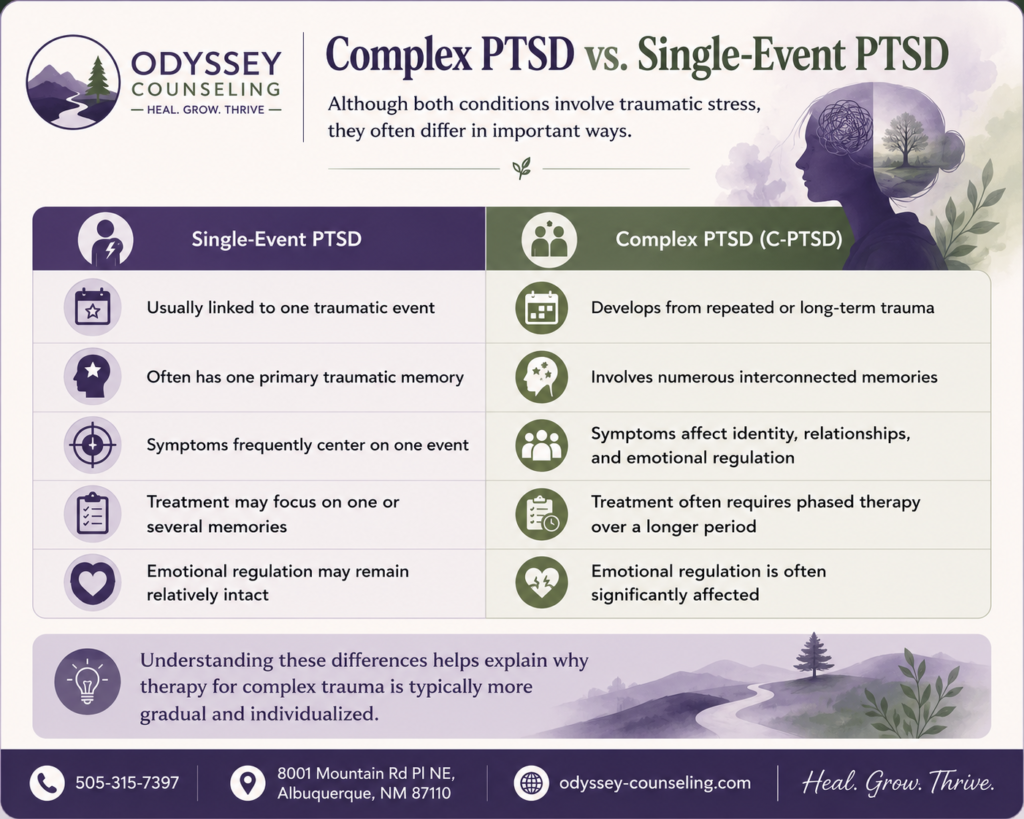
Unlike a single traumatic incident—such as a car accident, assault, or natural disaster—complex trauma develops over months or years. Many survivors grew up in environments where they never felt emotionally or physically safe.
Common experiences associated with complex trauma include:
- Childhood emotional neglect
- Physical abuse
- Sexual abuse
- Chronic criticism or humiliation
- Domestic violence
- Growing up with addicted or mentally ill caregivers
- Repeated abandonment
- Foster care instability
- Long-term bullying
- Witnessing violence in the home
Instead of one overwhelming memory, people with complex trauma often carry hundreds or even thousands of painful experiences that gradually shaped how they see themselves and the world.
This is why healing from C-PTSD typically requires a more comprehensive therapeutic approach than treating a single traumatic event.
Childhood Neglect: The Trauma Many People Don't Recognize
When people think about trauma, they often imagine dramatic events such as accidents or abuse.
However, childhood neglect can be equally damaging, even though nothing obvious may have happened.
Neglect occurs when a child's emotional or physical needs are repeatedly unmet.
Examples include:
- Rarely receiving comfort when upset
- Never feeling emotionally supported
- Parents who were emotionally unavailable
- Constant dismissal of feelings
- Growing up feeling invisible
- Lack of affection
- No encouragement or praise
- Inconsistent caregiving
Many adults minimize these experiences by saying:
"Nothing terrible happened to me."
Yet they continue struggling with:
- Chronic shame
- Fear of rejection
- Difficulty trusting others
- Emotional numbness
- Anxiety
- Depression
- Perfectionism
- People-pleasing
- Feeling fundamentally "not good enough"
These patterns often develop because a child's nervous system learned that emotional needs would not be met consistently.
As a result, survival strategies formed that once protected the child may continue affecting adult relationships, careers, and emotional well-being.
How Complex Trauma Changes the Brain and Nervous System
Complex trauma affects much more than memories.
It can influence how the brain processes stress, emotions, relationships, and even physical sensations.
Over time, the nervous system may become "stuck" in survival mode.
Instead of feeling calm and secure, the brain may constantly scan for danger—even when no immediate threat exists.
This can lead to symptoms such as:
- Hypervigilance
- Emotional flooding
- Dissociation
- Difficulty relaxing
- Sleep problems
- Panic attacks
- Irritability
- Persistent anxiety
- Difficulty concentrating
- Strong emotional reactions to seemingly minor situations
Many individuals blame themselves for these reactions.
In reality, these responses often represent adaptations that once helped them survive difficult circumstances.
One of the goals of trauma-informed counseling is helping clients understand that these reactions are not signs of personal weakness. Rather, they reflect how the brain and nervous system adapted to chronic stress.
This perspective can reduce self-blame while opening the door to meaningful healing.
Can EMDR Therapy Help Complex Trauma?
For many people, yes.
EMDR has been extensively studied for trauma treatment and has helped many individuals reduce the emotional intensity associated with traumatic memories.
However, treating complex trauma often looks different than treating a single traumatic incident.
Rather than immediately revisiting painful childhood experiences, therapists commonly begin by helping clients develop:
- Emotional regulation skills
- Coping strategies
- Grounding techniques
- Safe emotional resources
- Healthy boundaries
- Greater nervous system stability
Only after sufficient preparation does trauma processing begin.
This slower, phased approach helps reduce the risk of overwhelming emotions and supports safer, more sustainable healing.
Rather than asking clients to "relive" trauma, EMDR helps the brain gradually reprocess difficult memories so they become less emotionally distressing over time.
For many survivors of childhood neglect and C-PTSD, this process can lead to meaningful improvements in self-esteem, emotional regulation, relationships, and overall quality of life.
Why Stabilization Comes Before Trauma Processing
One of the biggest misconceptions about EMDR therapy is that treatment begins by immediately revisiting painful memories.
For people living with complex trauma (C-PTSD), that usually isn't the case.
Trauma-informed therapists recognize that individuals who have experienced years of abuse, neglect, or chronic emotional pain often need to develop a stronger sense of safety before processing traumatic memories. Rushing into difficult experiences too early can leave clients feeling overwhelmed rather than supported.
Instead, the early stages of treatment focus on helping clients develop the emotional and practical skills needed to navigate difficult feelings as they arise. This preparation phase is often called stabilization, and it is one of the most important components of successful EMDR therapy for complex trauma.
Stabilization may include learning how to:
- Recognize emotional triggers
- Regulate overwhelming emotions
- Calm the nervous system
- Practice grounding techniques
- Build healthy coping strategies
- Establish personal boundaries
- Develop self-compassion
- Strengthen trust in the therapeutic relationship
For some individuals, stabilization lasts only a few sessions. For others—especially those with significant childhood neglect or long-term relational trauma—it may take weeks or months before trauma reprocessing begins.
This isn't a setback.
It's often the foundation that allows healing to occur safely and sustainably.
Understanding the Eight Phases of EMDR Therapy
Although EMDR is often associated with eye movements or other forms of bilateral stimulation, those techniques represent only one part of a carefully structured treatment process.
EMDR follows an eight-phase protocol designed to support healing while minimizing emotional overwhelm.
Phase 1: History Taking and Treatment Planning
Your therapist begins by learning about your experiences, current symptoms, personal strengths, and treatment goals.
Rather than focusing on every painful memory immediately, they work with you to identify patterns and determine whether EMDR is the appropriate treatment at this stage.
For clients with complex trauma, this assessment often includes exploring:
- Childhood experiences
- Attachment relationships
- Emotional regulation
- Current stressors
- Coping skills
- Personal support systems
Phase 2: Preparation
Preparation focuses on building emotional safety.
During this phase, your therapist teaches techniques that help you remain grounded during difficult moments.
These may include:
- Deep breathing exercises
- Mindfulness practices
- Safe-place visualization
- Body awareness
- Emotional regulation strategies
- Relaxation techniques
Many clients discover that these skills improve daily life long before trauma processing begins.
Phase 3: Assessment
Together, you and your therapist identify a memory, belief, emotion, or physical sensation to address.
For someone with single-event PTSD, this may involve one clearly defined traumatic incident.
With complex trauma, however, treatment often focuses on broader emotional themes such as:
- "I'm not good enough."
- "I'm unsafe."
- "I'm unlovable."
- "I can't trust anyone."
- "Everything is my fault."
These deeply rooted beliefs frequently develop over years of childhood experiences rather than from one isolated event.
Phases 4–7: Trauma Reprocessing
These phases involve the bilateral stimulation most people associate with EMDR.
Your therapist guides you through carefully structured processing while continually monitoring your emotional state.
The goal is not to erase memories.
Instead, EMDR helps the brain process traumatic experiences so they become less emotionally overwhelming.
Many clients report that memories begin to feel more like events from the past rather than experiences that continue to control their present.
Phase 8: Reevaluation
At the beginning of future sessions, your therapist reviews previous work to evaluate progress and determine the next appropriate step.
Healing rarely follows a perfectly straight path.
Treatment plans are adjusted based on your needs, your progress, and how your nervous system responds throughout therapy.
Why EMDR Is Adapted for Complex Trauma
Complex trauma differs significantly from trauma caused by a single event.
Many survivors experienced years of emotional neglect, inconsistent caregiving, or repeated abuse during critical periods of childhood development.
Because of this, therapists often modify EMDR treatment in several important ways.
Adaptations may include:
- Spending more time on stabilization
- Processing memories gradually
- Addressing attachment wounds
- Working with emotional "parts" or internal conflicts when clinically appropriate
- Incorporating mindfulness and somatic awareness
- Frequently checking emotional tolerance throughout sessions
- Slowing the pace whenever needed
Rather than measuring success by how quickly memories are processed, therapists prioritize creating an emotionally safe environment where healing can unfold naturally.
Understanding the "Window of Tolerance"
One concept that often becomes central during complex trauma treatment is the Window of Tolerance.
This term describes the emotional zone where your brain and nervous system can process experiences without becoming overwhelmed or emotionally shut down.
When you're inside your Window of Tolerance, you can generally:
- Think clearly
- Stay emotionally present
- Solve problems
- Participate in conversations
- Learn new skills
- Process emotions safely
Trauma can narrow this window considerably.
As a result, even relatively small stressors may trigger intense emotional reactions.
Some people move into hyperarousal, experiencing:
- Panic
- Anxiety
- Anger
- Racing thoughts
- Hypervigilance
Others shift into hypoarousal, leading to:
- Emotional numbness
- Dissociation
- Feeling disconnected
- Fatigue
- Difficulty concentrating
- Feeling "checked out"
One of the primary goals of EMDR preparation is gradually expanding your Window of Tolerance so you can remain emotionally present while processing difficult experiences.
As this window grows, many clients find they respond to everyday stress with greater flexibility and resilience.
Healing Attachment Wounds
Many people living with complex trauma struggle not only with painful memories but also with the emotional impact of disrupted childhood relationships.
If caregivers were emotionally unavailable, unpredictable, or unsafe, children often develop survival beliefs that continue into adulthood.
These beliefs may include:
- "People always leave."
- "I have to take care of everyone else."
- "I can't trust anyone."
- "If people know the real me, they'll reject me."
- "I'm responsible for everyone else's emotions."
These beliefs aren't signs of weakness.
They often represent protective strategies developed during childhood to help navigate difficult environments.
EMDR therapy can help clients examine these deeply rooted beliefs, understand where they came from, and gradually replace them with healthier, more balanced perspectives.
This process takes time.
Healing attachment wounds is rarely about changing one memory. It's about reshaping long-standing patterns that influence relationships, self-worth, and emotional well-being.
Progress Looks Different for Everyone
One of the most reassuring aspects of trauma-informed counseling is recognizing that healing doesn't have to follow someone else's timeline.
Some clients notice improvements after relatively few sessions.
Others benefit from longer-term therapy that addresses multiple layers of trauma accumulated over many years.
Progress may include:
- Feeling calmer during stressful situations
- Sleeping better
- Experiencing fewer emotional triggers
- Improving relationships
- Developing healthier boundaries
- Feeling more connected to emotions
- Reducing anxiety
- Building greater self-confidence
- Experiencing increased hope for the future
These changes often happen gradually, reflecting meaningful nervous system healing rather than quick symptom suppression.
How Long Does EMDR Therapy for Complex Trauma Take?
One of the first questions many people ask is, "How long will it take before I start feeling better?"
The honest answer is that healing from complex trauma is highly individual.
Unlike treatment for a single traumatic event, Complex PTSD (C-PTSD) often involves years of painful experiences that shaped how a person thinks, feels, relates to others, and responds to stress. Because these experiences occurred over time, meaningful healing often requires patience and a personalized treatment plan.
Some people begin noticing positive changes after several sessions, such as:
- Feeling calmer during stressful situations
- Sleeping more soundly
- Experiencing fewer panic symptoms
- Becoming less reactive to emotional triggers
- Feeling more hopeful about the future
Others may benefit from longer-term counseling that focuses on gradually rebuilding emotional safety, strengthening relationships, and processing multiple traumatic experiences at a pace that feels manageable.
Rather than measuring progress by the number of sessions completed, experienced trauma therapists look for meaningful improvements in everyday life, including healthier relationships, greater emotional regulation, increased self-confidence, and an improved sense of personal safety.
At Odyssey Counseling, treatment plans are individualized because no two healing journeys are exactly alike. The goal is not to rush recovery but to help clients build lasting emotional wellness through compassionate, evidence-based care.
What If I Don't Remember Much of My Childhood?
Many survivors of childhood neglect or long-term trauma worry because they have gaps in their memories.
Some remember only scattered events.
Others remember very little at all.
This is more common than many people realize.
The brain sometimes limits access to painful memories as a protective response during overwhelming or prolonged stress. Memory can also become fragmented when traumatic experiences occur repeatedly over many years.
Fortunately, EMDR therapy does not require you to remember every detail of your childhood for treatment to be helpful.
Therapists often work with:
- Current emotional reactions
- Physical sensations
- Negative beliefs about yourself
- Present-day triggers
- Recurring relationship patterns
- Images or emotions connected to difficult experiences
Healing is not dependent on creating a perfect timeline of childhood events.
Instead, therapy focuses on helping your brain and nervous system process experiences that continue to affect your life today.
What Makes Trauma-Informed EMDR Different?
One of the most important aspects of effective trauma treatment is recognizing that clients are always more important than the therapy technique itself.
Trauma-informed EMDR emphasizes safety, collaboration, and flexibility throughout the counseling process.
Rather than following a rigid schedule, therapists continually adjust treatment based on your comfort level, emotional regulation, and readiness to process difficult experiences.
This may include:
- Slowing down when emotions become overwhelming
- Spending additional time strengthening coping skills
- Revisiting stabilization techniques as needed
- Celebrating meaningful progress rather than focusing only on symptom reduction
- Collaboratively deciding when to begin processing traumatic memories
Clients are never expected to "push through" overwhelming emotions simply to move treatment forward.
A strong therapeutic relationship, emotional safety, and trust remain central throughout the healing process.
Signs You May Benefit from Trauma Therapy
Many adults live with the effects of complex trauma without realizing their current struggles may be connected to earlier life experiences.
You may benefit from speaking with a trauma-informed counselor if you experience:
- Persistent anxiety or chronic worry
- Difficulty trusting other people
- Frequent feelings of shame or guilt
- Emotional numbness
- Intense reactions to conflict
- Recurring relationship difficulties
- Panic attacks
- Depression
- Low self-esteem
- Difficulty setting healthy boundaries
- Feeling constantly "on guard"
- A sense that you're surviving rather than living
Experiencing one or more of these symptoms does not automatically mean you have Complex PTSD.
However, they may indicate that speaking with a qualified mental health professional could help you better understand what you're experiencing and explore treatment options.
Frequently Asked Questions
Can EMDR help people with Complex PTSD?
Yes. Many individuals with Complex PTSD benefit from EMDR therapy when it is adapted to address long-term trauma. Treatment generally emphasizes stabilization, emotional regulation, and gradual processing rather than immediately revisiting traumatic memories.
Is EMDR safe after childhood neglect?
For many people, yes. EMDR is considered an evidence-based trauma treatment, but it should be provided by trained clinicians who understand the unique challenges associated with complex trauma and childhood neglect. Treatment should always move at a pace appropriate for the individual.
Can EMDR change painful childhood memories?
EMDR does not erase memories.
Instead, it helps reduce the emotional distress associated with traumatic experiences so they become less overwhelming and less likely to interfere with daily life.
Many clients report that memories begin to feel like events from the past rather than experiences that continue to define their present.
What if I become emotional during EMDR sessions?
Strong emotions can occur during trauma therapy, which is one reason preparation and stabilization are so important.
Your therapist will teach coping strategies, grounding techniques, and emotional regulation skills to help you navigate difficult moments safely.
Treatment should never feel rushed.
Can EMDR be combined with other types of counseling?
Yes.
Many counselors integrate EMDR with other evidence-based approaches depending on each client's needs.
These may include Cognitive Behavioral Therapy (CBT), mindfulness-based interventions, somatic techniques, trauma-informed counseling, and other therapeutic approaches that support long-term emotional wellness.
Hope and Healing Are Possible
Living with the effects of childhood neglect or Complex PTSD can feel exhausting.
Many survivors spend years believing they are somehow "broken" because they struggle with anxiety, relationships, emotional regulation, or self-worth.
In reality, many of these responses began as survival strategies developed during difficult circumstances.
The encouraging news is that healing remains possible.
With compassionate support, evidence-based therapy, and a treatment plan tailored to your unique experiences, many individuals learn to build healthier relationships, regulate difficult emotions, develop greater self-confidence, and move forward with renewed hope.
Recovery doesn't mean forgetting the past.
It means reaching a place where the past no longer controls your present.
Begin Your Healing Journey with Odyssey Counseling
If you or someone you love is living with the effects of Complex PTSD, childhood neglect, or other traumatic experiences, you don't have to face the healing process alone.
The compassionate team at Odyssey Counseling provides individualized, trauma-informed counseling for adults, adolescents, couples, and families throughout Albuquerque and Central New Mexico. Using evidence-based approaches such as EMDR therapy, trauma counseling, individual counseling, and other personalized treatment options, our licensed professionals work alongside each client to create a safe, supportive path toward lasting emotional wellness.
Whether you're seeking help for Complex PTSD, childhood trauma, anxiety, or another emotional challenge, we're here to support you every step of the way.
Contact Odyssey Counseling today to schedule a confidential consultation and take the first step toward healing, resilience, and hope.



 Listen In